AI Development · Healthcare
Healthcare AI Development
PHI-safe pipelines and a clinician in the loop for documentation, triage, and imaging support, so an AI tool earns trust before it asks for adoption.
NDA on request · Free, no-obligation estimate · Reply within one business day


Few domains let an AI system's output bear directly on a clinical decision, and that raises the engineering bar. A marketing tool that invents a plausible fact is an embarrassment. A clinical note or triage recommendation that does the same is a patient safety issue. Every design decision begins from that constraint.
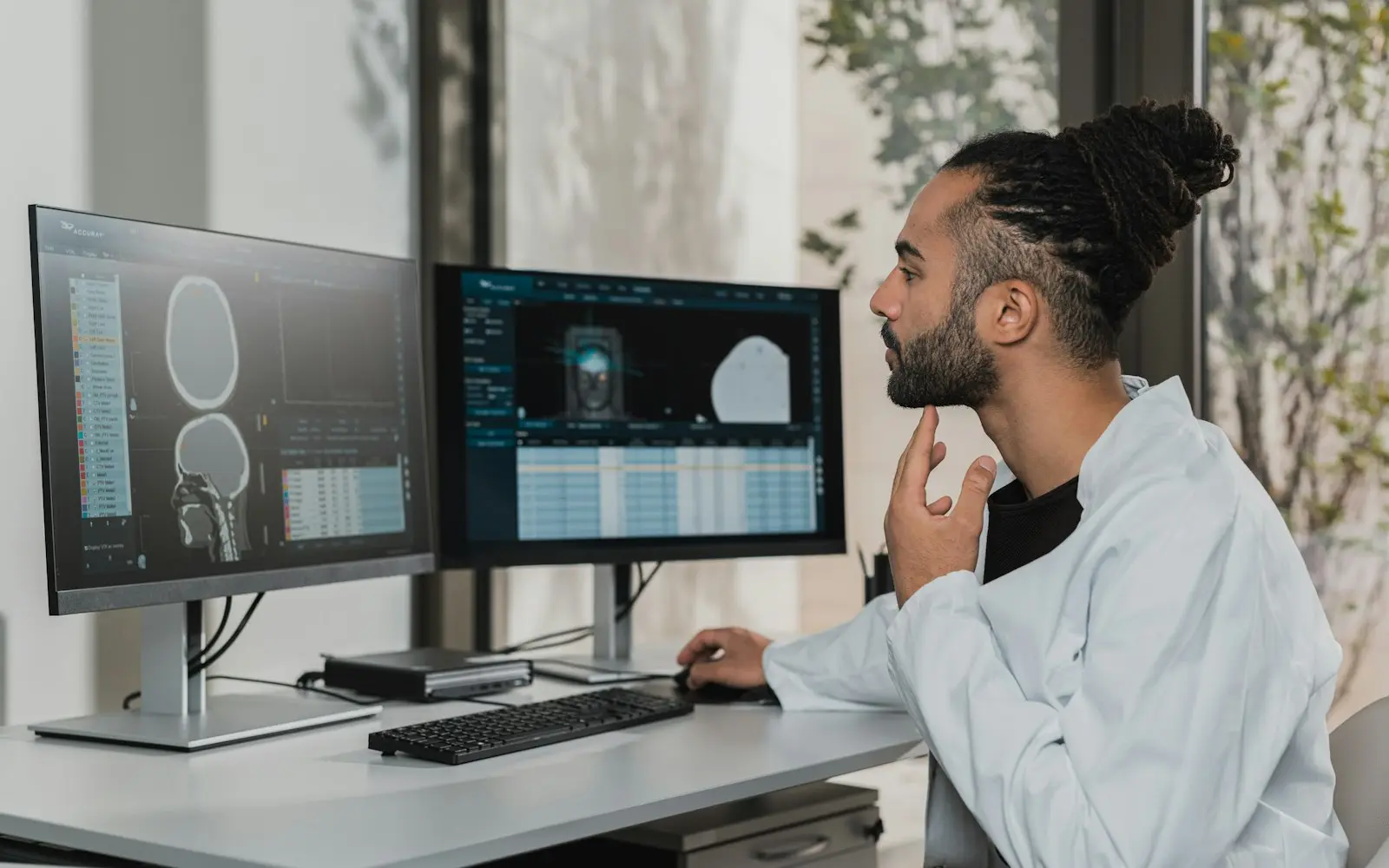
We build healthcare AI systems, ambient documentation assistants that draft clinical notes from a visit, intake and triage tools that support (not replace) a nurse's assessment, and applications that surface relevant information from imaging or lab results, with PHI kept inside a compliant data boundary and a clinician positioned to review and correct the model's output before it becomes part of the record. Training and inference data handling gets scoped against a signed business associate agreement from the start.
The recurring pattern is human-in-the-loop by design: the model drafts, flags, or suggests, and a clinician confirms. That is both the safer engineering pattern and the one hospital buyers actually want to see, since a system billed as fully autonomous invites exactly the liability questions their risk and compliance teams are trained to ask.
The problem
How healthcare projects differ
Keeping PHI inside a compliant boundary during training and inference
Any model that touches protected health information, even for inference, needs to run inside infrastructure covered by a business associate agreement, which rules out sending raw PHI to a general-purpose API without the right contractual and technical controls in place.
Clinical documentation accuracy under time pressure
An ambient scribing or note-drafting tool has to produce a draft accurate enough to save real time, but wrong often enough in ways a rushed clinician might miss the errors, so the review workflow has to make mistakes easy to catch.
Explainability for clinician trust
A clinician will not act on a model's suggestion they cannot understand, so triage or decision-support tools need to surface the specific inputs driving a recommendation, not just a confidence score.
Model validation against clinical outcomes
A model's accuracy on a benchmark dataset does not guarantee it performs the same way on your patient population, so validation needs to run against real, de-identified outcome data before deployment.
Where AI ends and a clinical decision begins
Regulatory scrutiny around AI that functions as a medical device increases sharply once a tool moves from drafting or flagging to making an autonomous clinical recommendation, so the product boundary has to be a deliberate, documented decision.
Scope
Features we often include
Ambient clinical documentation drafting
Visit audio or structured intake data used to draft clinical notes for physician review, reducing documentation time without removing the clinician from the final sign-off.
Human-reviewed triage support
Intake and symptom data scored to help prioritize patient queues, with the model's reasoning surfaced to the reviewing nurse or clinician rather than a black-box score.
PHI-safe data pipelines
Training and inference pipelines that keep protected health information inside infrastructure covered by a business associate agreement, with de-identification applied wherever the use case allows it.
Imaging and lab result assistance
Model-assisted flagging of findings in imaging or lab data for radiologist or physician review, structured as a second reader that supports the clinician's diagnosis.
EHR-integrated suggestions
Model output delivered inside the clinician's existing EHR workflow via HL7 FHIR, rather than a separate tool that requires switching screens mid-visit.
Model validation and drift monitoring
Ongoing evaluation of model accuracy against real outcome data, with alerting when performance drifts from validated baselines.
Audit trail for AI-assisted decisions
A record of every model suggestion, the clinician's action on it, and the final outcome, supporting both quality review and regulatory inquiry.
Compliance and standards
- HIPAA
- HITECH
- FDA considerations for clinical decision support tools
- HL7 FHIR
Common integrations
- Epic (via HL7 FHIR)
- Oracle Health (Cerner)
- Azure OpenAI Service (BAA-eligible hosting)
- AWS Bedrock
- Redox
Approach
How these projects run
We start by drawing a clear line around what the model will and will not decide, since that boundary determines both the regulatory posture and the engineering approach. A documentation-drafting tool with mandatory clinician sign-off is a very different build, and a very different conversation with a hospital's compliance team, than a tool that claims to make an autonomous clinical recommendation.
Once that boundary is set, we build the PHI-safe data pipeline first and validate it against your infrastructure's BAA coverage before any model development begins. Model output gets tested against real, de-identified clinical scenarios with clinician review built into the evaluation loop, not just an accuracy metric on a held-out dataset. Code and infrastructure stay in your repository from the first commit, and we sign an NDA before discovery begins.
Typical stack
Related solutions
Systems in this space
- AI Chatbot DevelopmentA chatbot that draws its answers from your own documentation, performs real actions in your systems and recognizes when to pass a conversation to a person.

- Document Processing AutomationAutomatic extraction of structured data from invoices, contracts and forms, with a defined review step for anything the extraction is unsure about.

- Telemedicine Platform DevelopmentVideo visits, intake and e-prescribing that meet HIPAA requirements and link to your EHR over HL7 FHIR as one connected system.

FAQ
Frequently asked questions
Can we use a general-purpose AI API for healthcare applications that touch patient data?
Only if the provider will sign a business associate agreement and the infrastructure meets HIPAA's technical safeguards, which is why we typically route PHI-touching inference through BAA-eligible hosting like Azure OpenAI Service or AWS Bedrock rather than a general consumer API. We confirm this coverage during discovery before any patient data reaches a model.
How does an ambient clinical documentation tool avoid introducing errors into the medical record?
The model produces a draft note that a clinician reviews and edits before it becomes part of the official record, with the review interface designed to make discrepancies easy to spot rather than easy to skim past. The tool is built as a drafting aid, and a clinician signs off every note.
What is explainability and why does it matter for a healthcare triage AI tool?
Explainability means surfacing the specific inputs, such as reported symptoms or vital signs, that drove a model's triage suggestion, rather than presenting a bare confidence score. Clinicians are far more likely to trust and correctly use a tool when they can see the reasoning behind a recommendation, and regulators increasingly expect this transparency for anything touching clinical decisions.
How long does it take to build a healthcare AI documentation or triage tool?
A focused pilot for one clinical workflow, such as ambient documentation for a specific visit type, typically takes a few months, including the PHI-safe pipeline setup and initial validation against real (de-identified) clinical data. Expanding to additional workflows or pursuing FDA clearance as a medical device extends the timeline substantially.
Does the AI tool need FDA clearance to be used in a clinical setting?
It depends on what the tool actually does. A documentation-drafting aid with mandatory clinician review generally sits outside FDA's software-as-a-medical-device definitions, while a tool that makes an autonomous diagnostic or treatment recommendation likely does not. We help define that product boundary early specifically to avoid an unplanned regulatory classification.
Explore
Keep exploring
- ServiceAI Development
- IndustryHealthcare software development
- HealthcareCustom Healthcare Software Development
- HealthcareHealthcare Mobile App Development
- HealthcareHealthcare SaaS Development
- AI DevelopmentFintech AI Development

- AI DevelopmentAI in Insurance Software Development

- AI DevelopmentLegal AI Software Development

Plan healthcare ai development with a free estimate
Send a short description of the project. A senior engineer reads each request and answers with questions, next steps and an early budget range.